
 We were told the last election was all about Education – Education – Education. This one should be NHS – NHS – NHS.
The road to privatisation of the NHS has been a long one and began under the Conservatives in 1992 with the Private Finance Initiative. It’s a neat trick that enables huge amounts of debt to be moved off the national balance sheet whilst still expanding operational infrastructure.
New Labour saw it as something too good to be true, as it allowed them to build new hospitals, without borrowing more money or raising taxes. But like most things that seem too good to be true, it was. By the end of their tenure Labour had saddled the NHS with £80Bn in repayments on total capital assets worth around £11Bn, and we’re still paying for it now.
Then along came the Conservatives again who just love to privatise things. Every time they’ve been in government they’ve privatised something. The trains, electricity, gas, BT, the post office – which they practically gave away.
But the Tories have a problem when it comes to the NHS. They can’t flat out privatise it, because that’s politically toxic.
So in 2012 – The year that Danny Boyle showed us in his spectacular Olympic opening ceremony what a glorious thing the NHS is – the Conservatives brought in the Health and Social Care Bill.
A bill that many people didn’t even notice passing through parliament. But a bill that arguably affects all of us more than any other legislation in our lifetime. A bill based on the premise that the NHS was a poorly performing institution that needed reform and another £3Bn top down reorganisation that we’d been promised before the election wouldn’t happen. A bill that ignored the core values of the NHS and characterised it’s staff as a problem to be dealt with rather than it’s greatest asset. A bill that achieved the Tory Nirvana of laying the NHS open to private contractors, furthering their ideology that the state should not be responsible for providing public services.
It effectively legislated against free universal comprehensive healthcare and flung the door to privatisation wide open. And private health firms are falling over themselves to come inside.
Jeremy Hunt has just announced £780Million worth of private contracts to 11 firms, many of which have a chequered history. Many of them are also donors to the Tory Party. There are also plans in Staffordshire to privatise cancer care in a £700M contract and ‘End of life care’ worth another £500M
In a leaked confidential document it’s proposed that these contractors will be :
“Given ‘discretion’ to design services they would like to deliver, slash spend per patient and propose the payment structures most beneficial to themselves”.
In that one clause we get a glimpse of how private companies will pervert the ethos of the NHS to their own end.
First the add on services will be an extra cost. Then any new treatments, drugs or therapies will be extra
In effect we’ll end up with a RyanAir NHS – Your operation will be free, but they’ll charge you £500 for the bed and another fifty for using the toilet.
The government consistently claims the NHS budget is protected but in reality, it’s being forced to make cuts dressed up as efficiency savings of £15bn – £20bn by the end of this year. No wonder we’re losing services. And across the country, A&Es, maternity and other services are being closed, with thousands of jobs lost. Competitive tendering also fragments healthcare. Where patients are sent miles to access different care resources around the country based on contractor costs.
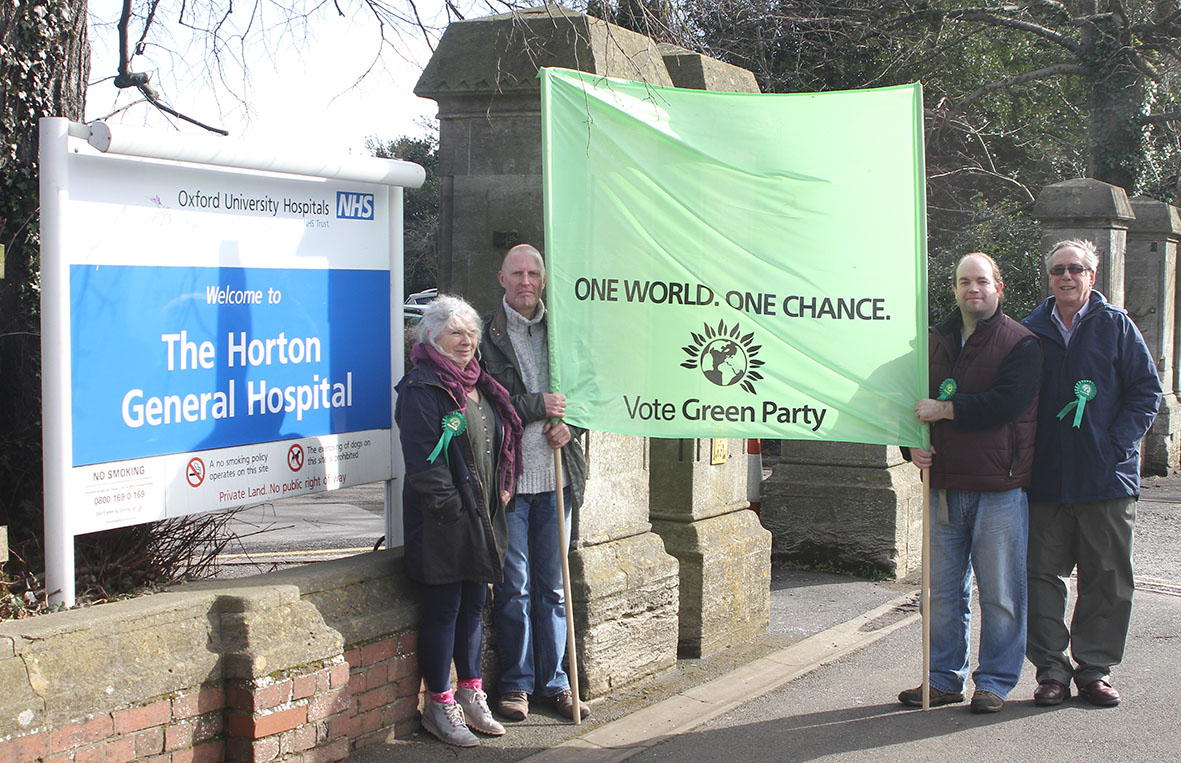
I’m standing as Parliamentary candidate for the Green Party in Banbury, where people are rightfully worried about that fragmentation and the future of their beloved Horton General Hospital. Labour have already tried to close it once, and more recently the coalition began a reduction in the range of services offered there, with the removal of emergency abdominal surgery facilities. This has resulted in some patients being forced to make a 3 or 4 hour, 50 mile round trip to services at the John Radcliffe Hospital in Oxford. Not only is this extremely inconvenient, it also potentially impairs patient outcome as additional stress is added to their situation.
Banbury has a long history of returning Conservative MPs, but this time every voter in the constituency has to ask themselves the question – do I still want to have access to a fully free and fully funded NHS in 5 years time?
If the answer is yes you have to remember that, no matter how much you might like the Conservative candidate this time (and I’ll admit I like her too), a vote for Victoria Prentis will just make another Tory led government more of a reality. No matter how much she says she’ll fight for the Horton, she’ll be forced to follow her party’s privatisation agenda. Even if she votes against the whip she’ll be a lone voice in a government she helped to put into power.
I want to see an end to all privatisation of the NHS and I believe the NHS should be brought back entirely into public ownership.
The Green Party supports the NHS re-instatement bill, we’d negotiate an exit from PFI and repeal the Health and Social Care Act. We’d also fight TTIP which could have a huge impact on the NHS. We believe that NHS staff deserve a fair deal and that they should be supported and valued rather than treated as a problem to be dealt with
Aneurin Bevan was once asked how long he thought the NHS would survive. He replied: “As long as there are folk left with the faith to fight for it.”
Every party is pledging to invest more money into the NHS but the Green Party won’t just invest cash, we’ll also invest our faith. We all have to show that faith now or by the end of the next parliament Danny Boyle’s proud Olympic love letter to our wonderful NHS could become it’s epitaph.
 Ian Middleton