Gallery

Your Vote Could Mean The End of the NHS

Horton - BlogWe were told the last election was all about Education – Education – Education. This one should be NHS – NHS – NHS.

The road to privatisation of the NHS has been a long one and began under the Conservatives in 1992 with the Private Finance Initiative.  It’s a neat trick that enables huge amounts of debt to be moved off the national balance sheet whilst still expanding operational infrastructure.

New Labour saw it as something too good to be true, as it allowed them to build new hospitals, without borrowing more money or raising taxes.  But like most things that seem too good to be true, it was.  By the end of their tenure Labour had saddled the NHS with £80Bn in repayments on total capital assets worth around £11Bn, and we’re still paying for it now.

Then along came the Conservatives again who just love to privatise things.  Every time they’ve been in government they’ve privatised something. The trains, electricity, gas, BT, the post office – which they practically gave away.

But the Tories have a problem when it comes to the NHS.  They can’t flat out privatise it, because that’s politically toxic.

So in 2012 – The year that Danny Boyle showed us in his spectacular Olympic opening ceremony what a glorious thing the NHS is – the Conservatives brought in the Health and Social Care Bill.

A bill that many people didn’t even notice passing through parliament.  But a bill that arguably affects all of us more than any other legislation in our lifetime.  A bill based on the premise that the NHS was a poorly performing institution that needed reform and another £3Bn top down reorganisation that we’d been promised before the election wouldn’t happen.  A bill that ignored the core values of the NHS and characterised it’s staff as a problem to be dealt with rather than it’s greatest asset.  A bill that achieved the Tory Nirvana of laying the NHS open to private contractors, furthering their ideology that the state should not be responsible for providing public services.

It effectively legislated against free universal comprehensive healthcare and flung the door to privatisation wide open.  And private health firms are falling over themselves to come inside.

Jeremy Hunt has just announced £780Million worth of private contracts to 11 firms, many of which have a chequered history. Many of them are also donors to the Tory Party.  There are also plans in Staffordshire to privatise cancer care in a £700M contract and ‘End of life care’ worth another £500M

In a leaked confidential document it’s proposed that these contractors will be :

“Given ‘discretion’ to design services they would like to deliver, slash spend per patient and propose the payment structures most beneficial to themselves”.

In that one clause we get a glimpse of how private companies will pervert the ethos of the NHS to their own end.

First the add on services will be an extra cost.  Then any new treatments, drugs or therapies will be extra

In effect we’ll end up with a RyanAir NHS  – Your operation will be free, but they’ll charge you £500 for the bed and another fifty for using the toilet.

The government consistently claims the NHS budget is protected but in reality, it’s being forced to make cuts dressed up as efficiency savings of £15bn – £20bn by the end of this year. No wonder we’re losing services.  And across the country, A&Es, maternity and other services are being closed, with thousands of jobs lost.  Competitive tendering also fragments healthcare. Where patients are sent miles to access different care resources around the country based on contractor costs.

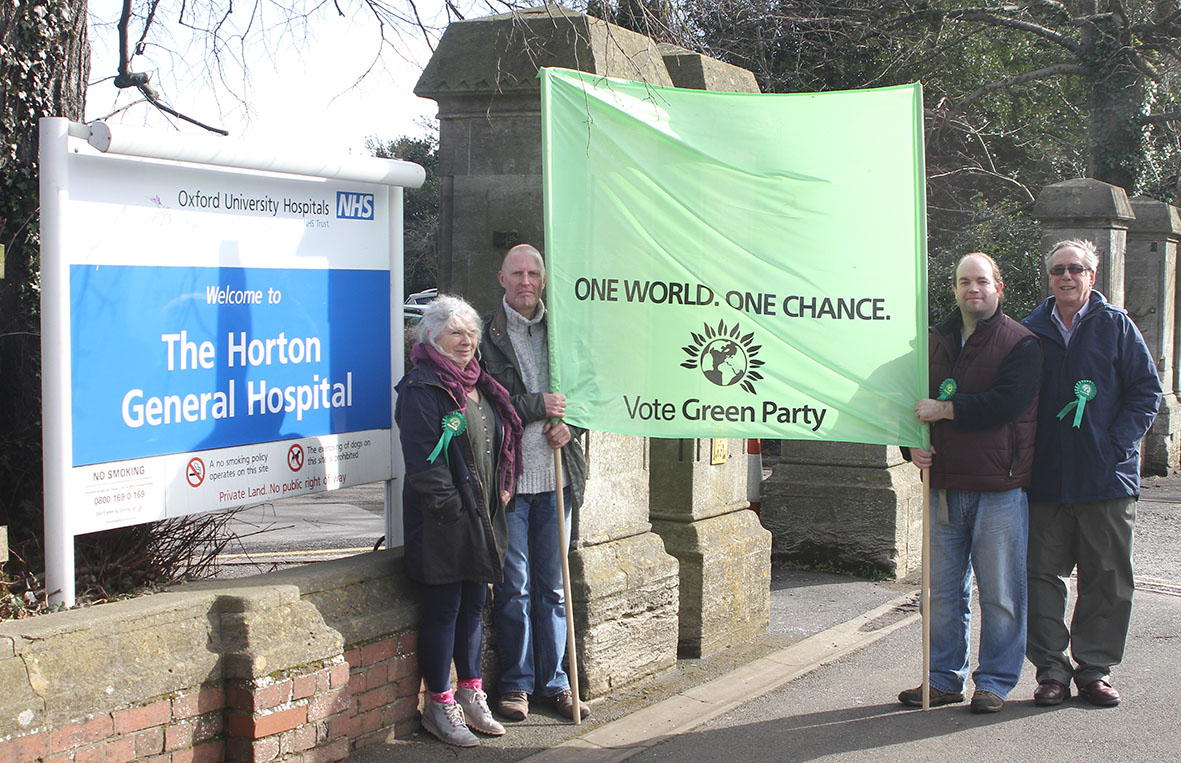
I’m standing as Parliamentary candidate for the Green Party in Banbury, where people are rightfully worried about that fragmentation and the future of their beloved Horton General Hospital.  Labour have already tried to close it once, and more recently the coalition began a reduction in the range of services offered there, with the removal of emergency abdominal surgery facilities. This has resulted in some patients being forced to make a 3 or 4 hour, 50 mile round trip to services at the John Radcliffe Hospital in Oxford.  Not only is this extremely inconvenient, it also potentially impairs patient outcome as additional stress is added to their situation.

Banbury has a long history of returning Conservative MPs, but this time every voter in the constituency has to ask themselves the question – do I still want to have access to a fully free and fully funded NHS in 5 years time?

If the answer is yes you have to remember that, no matter how much you might like the Conservative candidate this time (and I’ll admit I like her too), a vote for Victoria Prentis will just make another Tory led government more of a reality.  No matter how much she says she’ll fight for the Horton, she’ll be forced to follow her party’s privatisation agenda.  Even if she votes against the whip she’ll be a lone voice in a government she helped to put into power.

I want to see an end to all privatisation of the NHS and I believe the NHS should be brought back entirely into public ownership.

The Green Party supports the NHS re-instatement bill, we’d negotiate an exit from PFI and repeal the Health and Social Care Act.  We’d also fight TTIP which could have a huge impact on the NHS. We believe that NHS staff deserve a fair deal and that they should be supported and valued rather than treated as a problem to be dealt with

Aneurin Bevan was once asked how long he thought the NHS would survive.  He replied: “As long as there are folk left with the faith to fight for it.”

Every party is pledging to invest more money into the NHS but the Green Party won’t just invest cash, we’ll also invest our faith.  We all have to show that faith now or by the end of the next parliament Danny Boyle’s proud Olympic love letter to our wonderful NHS could become it’s epitaph.
Gallery

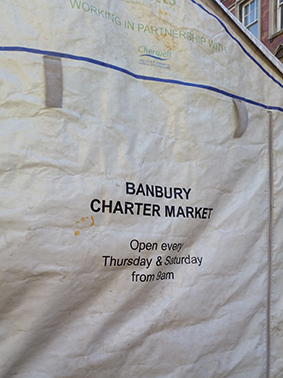
Visit to Banbury Market 17th January 2015

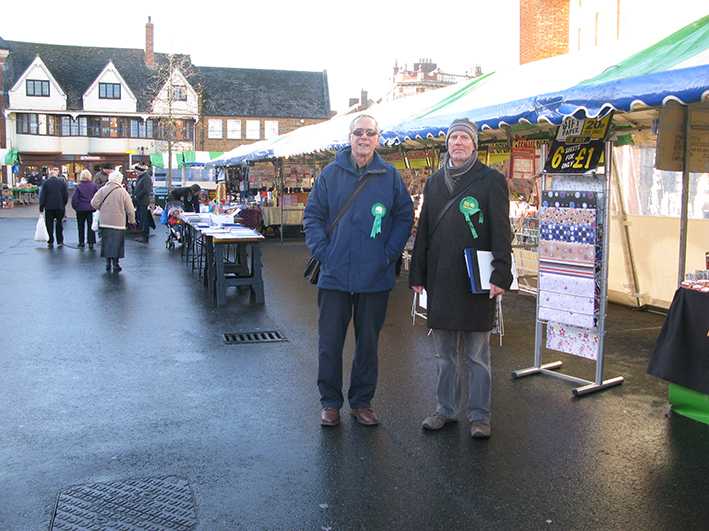
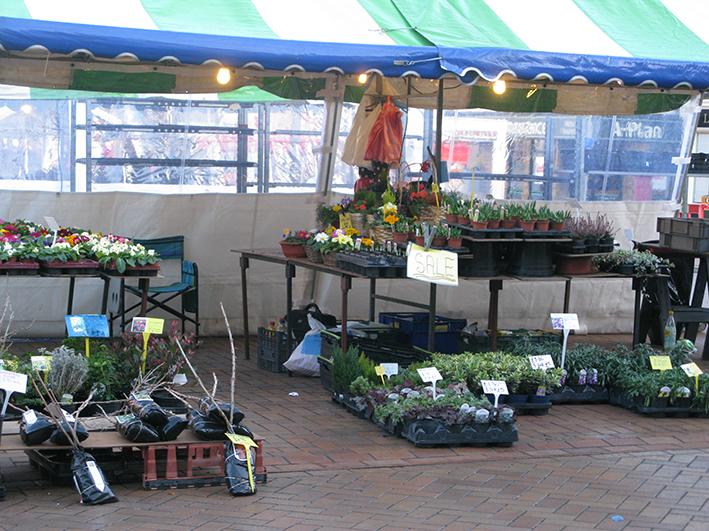
market sheetLast week myself and John Haywood from the Banbury and Cherwell Green Party visited the market in central Banbury to speak to the stall holders about the changes being proposed to this 1000 year old tradition in the heart of an historic town.

We spoke with all the stallholders present, although sadly they were only 10 of them trading on the day.  They were all all opposed to Cherwell District Council’s illogical and damaging decision to restrict the stalls to the Cornhill end of the Market Place.  A plan also supported by the Conservative controlled Town Council.

I started my own 25 year long retail career on a market stall, and worked it for 7 years with my partner though rain, hail sleet, snow and sunshine.  I know how difficult it can be to make a living and how fragile the trading environment can be.  Your livelihood can depend on so many variable factors, and one of the major fears is losing your regular pitch, for whatever reason.

It may seem silly to anyone who hasn’t traded in a market themselves, but where your stall sits can make all the difference between success and failure.  The location of competing trades, the flow of people moving through the market, who your neighbours are, your visibility and prominence in the market as a whole are all desperately important.

There appears to have been absolutely no consultation with stall holders or customers about these unpopular changes, and based on what stallholders and visitors told me I foresee them being the death knell for this historic trading post as more and more traders fall by the wayside.

So what seems like a minor change to the council, will probably be anything but to the people trying to make a living out of the market.  This move could likely kill it off!  it’s already become smaller and therefore less popular, especially over the last 20 years. In 1997 there were 120 stalls, now its down to less than 20.

Considering it’s reduced pull for consumers it’s completely incongruous that the rents being charged by the private firm managing on behalf of the council are almost double that charged by neighbouring markets such as Abingdon, Aylesbury, Hinkley, Oxford and Thame.  And as with most things these days, the rent goes up every year.  Meanwhile trade is slowly dwindling away to nothing, leaving regular and loyal traders quite literally out in the cold.

saleThe Council’s plan includes opening the Market car park for use on Thursdays and Fridays. There is no evidence to suggest this will increase car park usage and revenue to the Council – people already using other car parks such as that near to the Matalan Store will simply park in the market place instead.

Government initiatives on town centre regeneration called for more emphasis and support for market days and the traders that build and run these vital hubs of trade and local amenity in our towns and cities.  The Portas review cited markets as one of the easiest ways that town centres could be revitalised and kept alive.  Why then is the Conservative run Cherwell Council ignoring the views of it’s own established market traders?  Why are they proposing moves that could potentially irreparably damage trade in such an established and once vibrant local fixture?

Banbury market should be seen by Cherwell Council as an asset to the town.  They should be supporting it actively and engaging with the traders and customers to find ways of safeguarding the it’s future, rather than taking unilateral actions with no consultation.

This is a Charter Market, which bestows on Banbury the status of a Market Town.  By birthright it should be located in the Market Square.

I would urge Cherwell councillors to do what I did.  Take a walk around the market and speak to the people whose livelihoods are in their hands.  Speak also to the local residents and patrons of the market and ask them what they think about the priorities that they are planning to enforce on everyone.

This is not a decision that can be taken just by moving squares on a map.

me and john landscape

Gallery

Carry On Westminster – The Tops Trumps of British Democracy

Green SupermanThis is a piece I wrote for Huffington Post earlier this week.  I think it speaks for itself, although after it was published I thought I should have pointed out that none of the the politicians I refer to in the studio on election night were Greens.  As usual we weren’t invited to the BBC party.  There were however representatives from Labour, Conservative, Libdems and UKIP.  Given that the Greens had a reasonably good showing in the last General Election in Rochester (for a ‘marginal’ party) I’d have thought we’d have been worth a mention at least.  But apparently not.

Anyway I hope this serves as a good first post on my website/blog and you can see the original article here  http://www.huffingtonpost.co.uk/ian-middleton/westminster-politics_b_6199214.html?utm_hp_ref=tw.

Feel free to comment below or on the original article on the Huffington Post site.


I recently became a parliamentary candidate for the Green Party. After years of railing against politicians, the irony, and perhaps the hypocrisy, of becoming one myself has not been lost on me.

Then again, there were the constant jibes about my complaining a lot but doing nothing positive to make a change. So when my local party group asked me to stand, I said I’d give it a go. And here I am. Feel free to point the finger.

One of the first things I’ve noticed about the underbelly of politics is just how strategic it is. Target wards, target seats, candidates standing in constituencies where they don’t live for the sake of political expediency. None of this is new, or unusual, or even un-democratic, but it does take some getting used to.

But watching the BBC election special on the Rochester and Strood by-election, you could be forgiven for thinking that the rest of the political world has turned into some kind of wife swapping party from the mid 70s. It seems these days that political manoeuvring between the ruling parties has moved beyond juggling their own family jewels, and has been reduced to chucking their keys into the fruit bowl with anyone who fancies a quick fumble with their majority.

Firstly we had UKIP’s Deputy Chairperson Suzanne Evans being interviewed about where her party would go after the predicted win in Rochester. This consisted of a serious of nods and winks about who might and might not leap out of their own party bed and sneak into theirs when the neighbours weren’t looking. A sort of Carry-On Westminster, but with less laughs.

She then went on to explain, with barely concealed glee, that her fondest ambition was to seduce someone from Labour to join in their little tryst. Nigel is apparently talking to a couple of MPs but she couldn’t reveal more. She did everything but tap the side of her nose, elbow Andrew Neil in the ribs and give a little Babs Windsor giggle.

Then we had an analysis from a political expert explaining how UKIP’s performance in the by-election would determine how other sitting MPs would behave in the run up to next years general election. His premise was that if UKIP did well in Rochester, many other career politicians would be considering their position in the next few months. The expectation is apparently that if they think UKIP is a better bet for them to hold on to their seat (ooh matron!), then they would switch allegiances in order to do so.

Now you’ll have to excuse me. I’m quite new to this game. But when one joins a party isn’t there something about ideology written into the contract? Or am I now being ridiculously naive?

Judging by the behaviour of at least two recent pantheons of British democracy I suppose I am. It seems that standing on a platform with a bunch of like minded individuals in the hope of doing something good for the country isn’t what it’s about any more.

No, apparently it’s more about hanging on to the House Of Commons parking place, the expense account, and access to the House of Commons bar, rather than the boring stuff like philosophical conviction. Some back-benchers are evidently more interested in maintaining a comfortable position for themselves, rather than for their constituents. Yet, in true British carry-on style, they still keep getting elected.

As a newcomer to this world, I saw with fresh eyes last night these four sombre suited politicians sitting uneasily with each other, smugly carving up the political cake amongst themselves. Like children at birthday party trying to decide who gets the last portion of jelly and ice cream, the polemic was about anything other than the issues that this country and the planet really face.

Iain Duncan Smith spent a good deal of his time justifying a particularly vituperative campaign poster that portrayed the idea of voting for Mark Reckless as on a par with seeking Pol Pot as a spiritual adviser. Reckless used to be an investment banker, he didn’t live in the area, he’d only moved there to take a safe seat. All very salient points for the local electorate, but ones that seemed exquisitely irrelevant when he was the Conservative MP only a few months ago.

Meanwhile UKIP expounded their claim that they listened to the people, and were offering an alternative to the status quo of careerist politicians who’d never done a days honest labour in their lives. Odd then that their success last night, and in Clacton a few weeks ago, relied on exactly the reverse of those ideals by welcoming with open arms two MPs firmly rooted in the rotten political establishment they claimed to despise.

On the point of principle I am in total agreement with them. The current political establishment has reduced democracy to the level of swapping football cards in the playground. But it’s a tawdry game of top trumps that they have just as much of a hand in as all the other entrenched Westminster parties.

If this is the future of politics in this country, I’m glad to be a member of a party that currently stands as an exemplar of how it is still possible to operate democratically without playing these cynical games. We may now have one less MP than UKIP, but at least ours is there on merit, rather than because she swapped her rosette for a more appealing colour.

And Caroline Lucas has just won MP of the year, which is something that gives me hope. Even so, she’s now the focus of a campaign to unseat her by the Labour party in Brighton, because, and despite of the fact, that Labour and the Greens share many of the same aims.

Moreover, if all these people care about is hanging on to their positions at all costs, what really is the point? And if the electorate is so fickle that they can’t see through this charade, maybe we deserve the graceless, flagitious mess they all seem to be making of the world.

One apocryphal anecdote from Rochester I heard today was that someone had voted UKIP because the sitting Tory MP hadn’t done enough for the local area. If that’s true, it’s an indictment of the great British voter more demoralising than anything supposedly implied by hanging a flag out of the window of your mock-Georgian semi.

But as an accidental politician I have to hope that it isn’t true, or at least typical. I have to trust that people in the UK will see past all the identikit politicos, the vested interests and the horse trading of their democratic heritage, and vote for real change and genuine representation in the next government.

I am ever the optimist.