Gallery

High Street Recovery Needs Input from People Who Have Been on the Inside

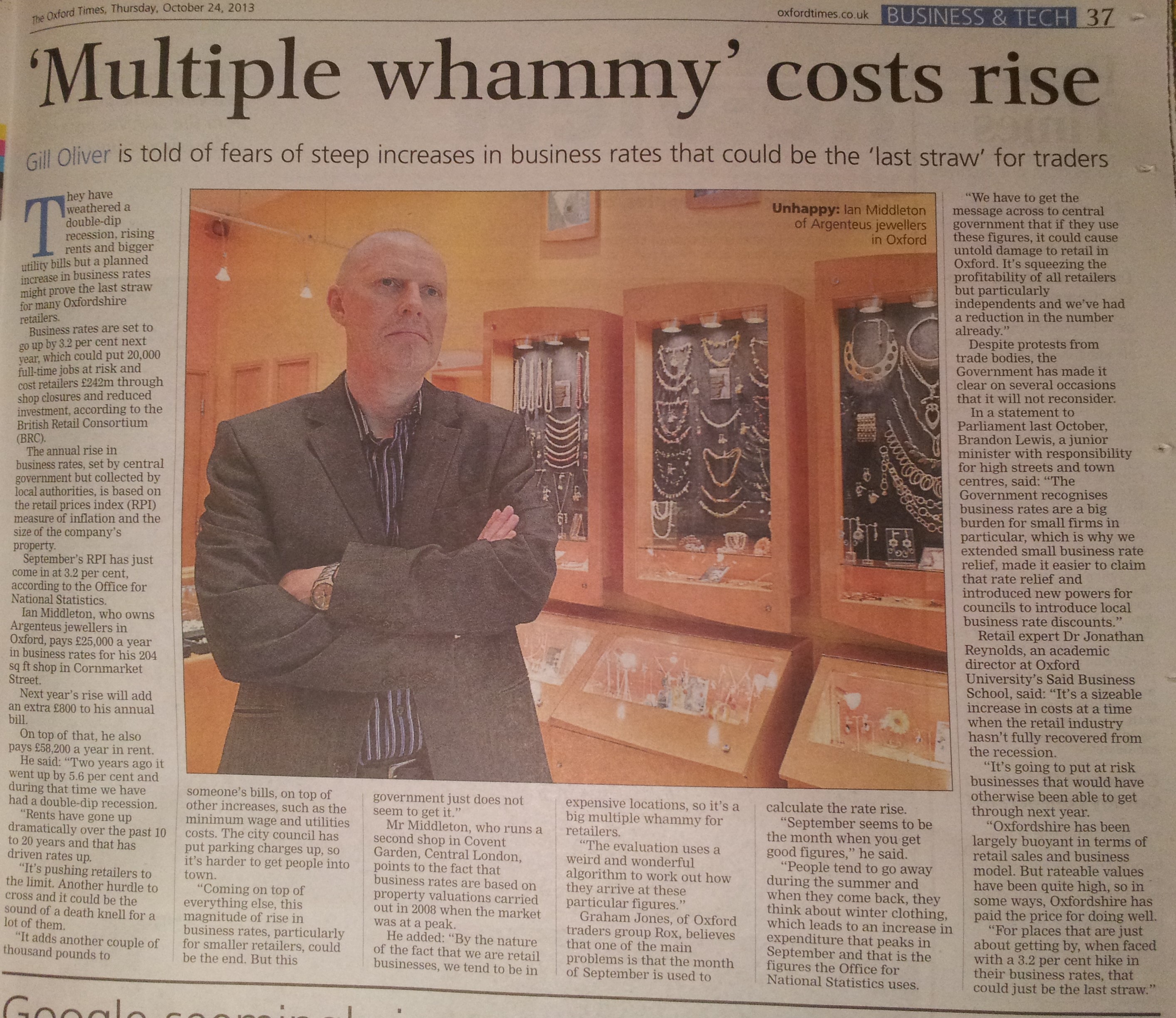
I’ve been involved in retail for as long as I can remember. From my first proper job as a Saturday boy in a menswear store in Lewisham through my days as a market trader in Camden Lock and Greenwich to being co-founder of a national high street chain that started with a small store in Oxford selling silver jewellery. and grew into a national chain trading in 6 of country’s major retail locations, including London’s prestigious Covent Garden.

In that time I saw almost as many ups as I did downs. I’ve half jokingly said that I spent 20 years building the business and then another 10 trying extricating it from the failing high street. Like so many other retailers who entered the high street during the boom years in the early 1990s, I fell foul of the simultaneous boom in commercial property development. So many new malls were opened in the 90s and early 2000s it was difficult to keep up and I opened stores in some of the most iconic examples such as the New Bullring in Birmingham and Bluewater in Kent.

The other boom at the time was in business rates, which along with rents skyrocketed through that period as institutional landlords, mostly backed by large pension funds, cashed in on the retail bubble ploughing millions into new shiny malls based on the emerging US model. It was great while it lasted and we all became caught up in the heady days of seemingly limitless opportunities. But we soon discovered there were limits.

The Financial crash in 2008 gave us all a pretty sharp reality check and things soon started to become far less buoyant and rents that had been agreed on the back of rude profit margins started to look far less tenable as turnovers started to fall.
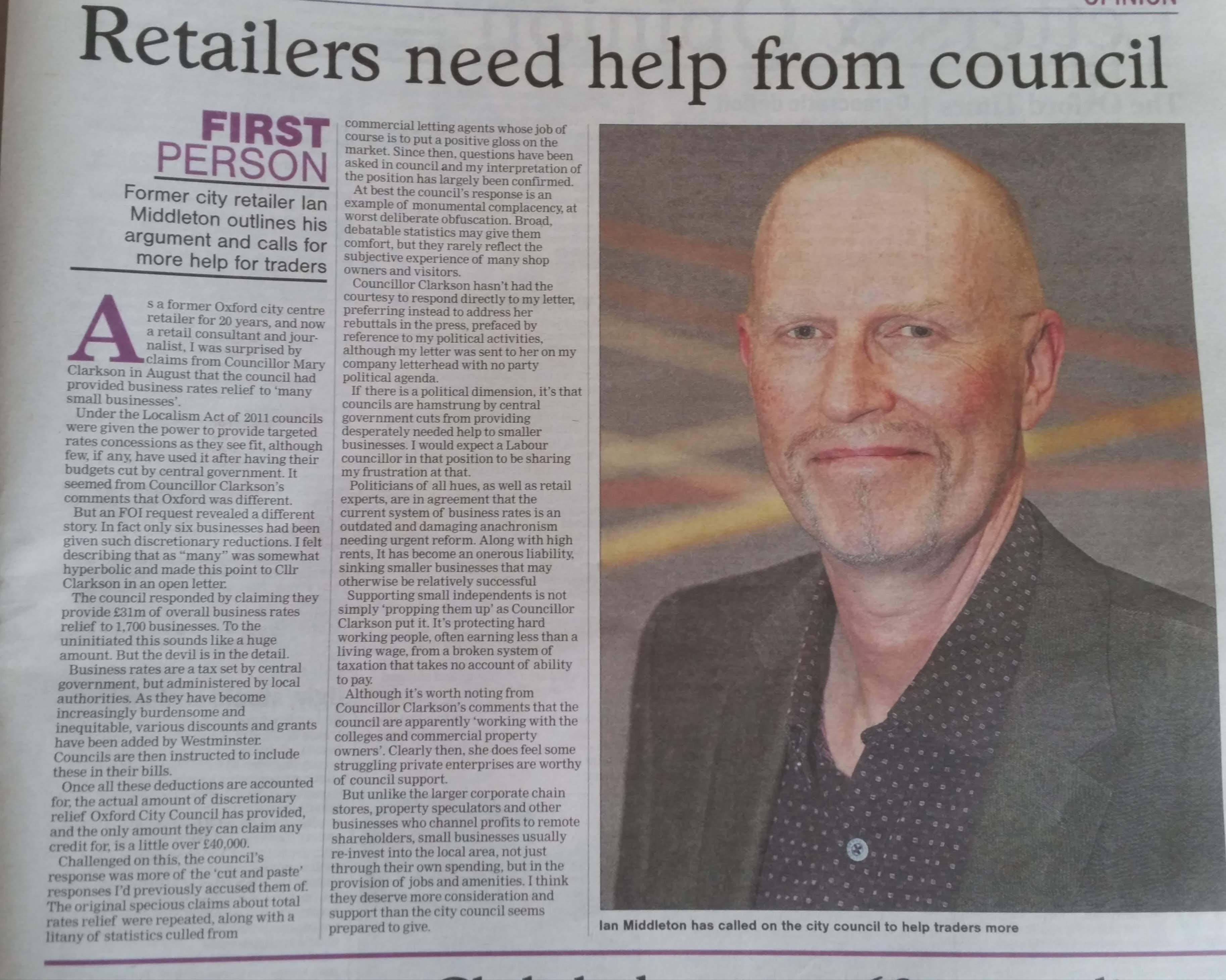
I’ve been fighting for a fairer deal for High Street retail for over 15 years

There soon followed a series of frantic rounds of renegotiation with landlords who themselves were facing the prospect of huge hole in their new developments as retailers started to fall over with alarming regularity. In many cases we were able to come to mutual agreements to keep us trading at the shopping malls looking full, but the one thing that couldn’t be re-negotiated were business rates. Set as they were, by the central valuation office, and administered by local authorities, they were completely devoid of any chance of concession unless you had an understanding council. In my experience their understanding was rather limited, and after 5 years as a local councillor myself I now understand more about why that was.

So we were all caught in a perfect storm that only a few managed to emerge from. My business was one of the luckier ones as I managed to negotiate deals that gave us breathing space. But I could see the writing on the wall and it was telling me to get out of the high street and decamp to the internet where so many of our competitors were lurking. Thereby hangs another very long story.

But suffice to say I have an intimate understanding of the plight of the high street, in fact much more intimate than I would prefer. For that reason one of my personal priorities as a fresh faced new MP would be to push for a new system of business rates or local high street taxation. Other things like rent controls and use classes would also be high on the agenda, but none of this will be an easy fix for an industry in the doldrums after so many years in decline. But I know from my own experience that smaller independents are both the lifeblood of local high streets whilst also being the most vulnerable.

In terms of the dreaded business rates, I think I could take elements from the land tax approach of the Green party and add in some aspect of a local purchase tax as seen in the USA. Such a tax would be far more progressive and have more respect for the ability of businesses to pay such an additional tax. That would give a far greater connection between the local community, local authorities and the retailers themselves. If all retailers did well then they would all reap the benefits.
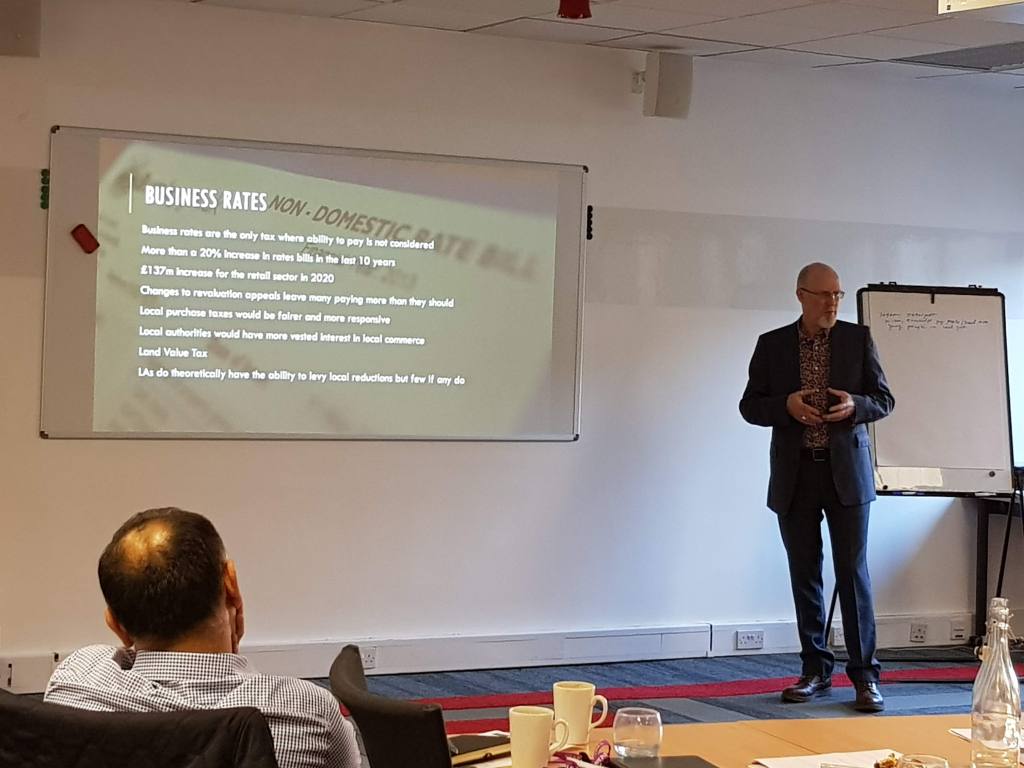
Speaking to local councillors and retailers about business rates reform

I don’t really have the answer to full business rates reform, but I’ve been campaigning for a better system for over 10 years. I would advocate a situation where we involved existing high street retailers in the process of finding a solution. There have been past attempts at doing this, but very few, if any, involved small independent retailers. I think that was a mistake.

The Labour Party have boldly announced that they would scrap the current business rates system, but they haven’t said what they would replace it with. I’ve been here before many times, and both Labour and the Tories have frequently promised reform but never delivered on that. One of the biggest reason is that business rates are a virtually guaranteed income for government bringing in over £13bn a year. Even if the premises are empty, the landlord cops for the bill so it’s a win-win for Westminster. So any new system is likely to be just as iniquitous and damaging, especially to smaller operators.

I think there is a way of developing a system of local high street taxation that could benefit all sides of the equation, including the consumer. Just scrapping the business rates system with no plan for what would replace it is not a solution, yet its the current proposal from the part that is most likely to form the next government in a few weeks. If I was in Westminster I’d hope to be able to provide a far better insight into the problems on the high street and how to engage with the people who face those problems every day.
I’d like to see genuine consultation with high street stakeholders, including landlords and local councils, about the best way forwards. As a long term retailer, having moved from being a small business, through a larger expansion and back to being a ‘born again independent’, I’d like to be involved in that process. But I guess it remains to be seen what the outcome is on July 4th.

I’ve just published a video I made during a recent visit to Bicester with some thoughts on how we can work towards a better system of high street business taxation and help to repair our broken high streets and you can watch that by clicking here.

If you’re a retailer or just someone who enjoys browsing physical shops, I’d suggest you vote for someone like me who has the experience to make that a viable possibility again. Retail is at the heart of every village, town and city and needs political support to make it vibrant again. Many politicians claim to have the answer but few of them have been on the inside of the industry. I think that needs to change. I’d like to change it.

Gallery

Cherwell’s Reckless Investment in a Struggling Shopping Centre Leads to Cuts in Services and Increased Charges for all Cherwell Residents

Cherwell District Council announced it’s budget last week detailing £4.4m in cuts and extra charges that it will be imposing on the residents of Cherwell as well as an increase in council tax.

During the budget debate I raised my concerns that around a third of these cuts and charges were as a result of losses incurred over the past two years in Banbury

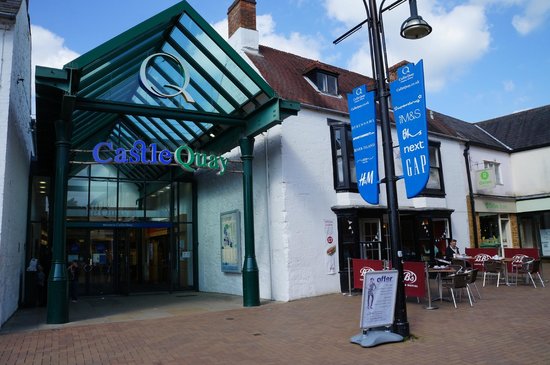
In a nutshell the centre is predicted to make a loss of around £1.6m in the 21/22 financial year after having made a similar loss in 20/21.  On a broader scale, taking into account some small gains in the first 2 years the council owned the development, it will have racked up losses in the region of £2.5m by the end of the next financial year if the current predictions are correct.  To close the gap left by that hole in the budget there have been additional service cuts with around a third of those in the forthcoming budget directly attributable to pressures from Castle Quay. 

You may have seen some of this in the press this week in Oxford Mail and the Banbury Guardian

I was also interviewed by BBC Radio Oxford, although my section was recorded and heavily edited, after which Cllr Tony Ilot ,the Lead Member for Financial Management & Governance on Cherwell District Council, was invited on the show live to respond.  If we’d been on at the same time I might have pointed out that as the councillor responsible for this development it would have been more encouraging had he bothered to do his homework before coming on.  At one point he seemed uncertain about how much the losses amounted to (he guessed at £1.3m and the interviewer had to correct him that it was £1.6m) and he also claimed that the £1.6m was a cumulative loss since the council took ownership.  It’s not, it’s just the predicted loss for the forthcoming year on top of a similar one for the last year. You’d think the Lead Member for Financial Management & Governance might have been a little more cognisant of the situation given the scale of problem, but this lack of concern over important details is a familiar theme with Cherwell’s Conservatives.

Cllr Ilot also seemed quite laid back about the fact that the centre is now worth less than half what was paid for item having lost a whopping £30m in value.  They are also currently spending even more than the original purchase price for the shopping centre on the canal side extension which, as a retail analyst myself, I think they are going to struggle to make a return on.

You can listen to the interview in full here 

The council’s line on this has been that the losses at CQ have not directly resulted in an increase in the council tax. As that increase was already in the pipeline anyway that’s probably fair to say, but it also fair to say that if this white elephant wasn’t providing such a huge financial drag on the council’s resources, we may not have needed to increase the tax and we certainly wouldn’t have need many of the cuts in services.

It will be interesting to see how much support we get for the high street in Kidlington and the Exeter Close project in the light of all this.  Certainly something we can point them to if they start penny-pinching on our project to support the eye-watering amounts of public money that’s being poured into one scheme in the far north of the district that we’re all footing the bill for.

Gallery

My response to Cherwell District Council’s 2021/22 Budget

At the full meeting of 22nd February Cherwell District Council passed their budget for the forthcoming financial year. I spoke in the debate criticising a further lack of response to the climate emergency and highlighting the pressures that the council’s reliance on commercial investments have placed on its finances, in particular its ownership of the Castle Quay shopping centre in Banbury.

I’ve long been a critic of the decision to risk council tax payers money by investing in a shopping centre that was already starting to show signs of distress. It was a quite ludicrous decision at the worst possible time, just as the retail economy was collapsing. As a retail analyst myself I’m acutely aware of the pitfalls of investment into retail space with provincial shopping centres being some of the most challenging developments to achieve a viable return on now.

I and fellow members of the council have been excluded from the so-called cross party advisory group on the management of Castle Quay which is entirely composed of Conservative and Labour councillors. Labour supported the purchase of Castle Quay in 2018 for £63m with a further commitment of a similar sum to build a canal-side extension, including a cinema and a hotel.

Looking at the figures in this budget we can see that around a third of the financial pressures are a result of losses attributed to Castle Quay. Even if the council’s own optimistic predictions are correct, by the end of next year Castle Quay will have returned a loss of around £1.9m since the council took full ownership.

The value of the centre is now around half what was paid for it, amounting to a whopping £30m loss of equity in an investment backed by council-tax payers money!

Of course all this is now being blamed on the pandemic, but that’s only part of the story. This was always a reckless investment, and that recklessness has now translated into service cuts for everyone in Cherwell.

Whilst I agree that councils should be the drivers of town centre regeneration, that needs to be evenly distributed. Ownership of Castle Quay is likely to produce only dubious benefit to the people of Banbury with a potentially massive financial burden that will be felt by every Cherwell resident for years to come”

As a retail analyst and adviser, I made my misgivings about the public purchase of a struggling shopping centre clear to the council, even before I was a councillor, but was ignored.

I knew there were already signs of problems on the horizon with several of the major tenants of the scheme, not least Debenhams which recently collapsed into administration.  That failure is yet another problem that is about to hit the beleaguered development when lockdown is lifted.

The much vaunted opening of Lock 29 indoor market in the space previously occupied by one of the other failed anchor tenants – BHS – is yet to prove itself viable.  While I support the inclusion and encouragement of many of the smaller enterprises that were invited to trade there, it’s notable that the major occupier, Happerley, pulled out last year after only 3 months. 

I have asked several questions of the council about Happerley’s involvement with the scheme and the due diligence that went into licencing that company to trade there in the first place.  Those questions remain unanswered.

I originally supported the extension of the scheme with more canal-side restaurant and leisure uses, but as time has gone on it’s becoming apparent that even that is a dubious move. One of the major parts of the development is a cinema, and we are already seeing a market shift there with several of the large cinema operators closing venues and some going into administration

Little focus on climate change

We’ve just had a taste of the pressures a global catastrophe can place on our finances.  In the coming years, ecological threats will make the pandemic look like a mini-break.  Yet 2 years into our declaration of a climate emergency, we have another budget with very little progress towards tackling that threat.

The last budget had a tiny percentage of spending dedicated to the ecological emergency and even that wasn’t fully honoured.  This one has just 5 short paragraphs – less than a page of vague aspirations with no real commitment to anything.  Added to that we’ve increased charges for making homes more energy efficient, the very thing we should be encouraging!

Last year’s budget was billed as Cherwell’s “greenest budget ever” yet many of the pledges made then remain unfulfilled, not least the promise to convert lighting at Bodicote House to LED which would have saved the council money as well as helping to save the environment.

On top of that we also have increased building regulations charges for thermal upgrades to buildings and for the installation of solar panels. These are the very things we should be encouraging residents and businesses to do. Many councils don’t charge at all for Solar Panel installations

It’s becoming clear that Cherwell’s ruling Conservative members simply don’t understand the meaning of the word ’emergency’.  We need to be taking bold steps towards tackling climate change, but the Conservatives would rather simply box tick and greenwash with projects that are either not of their making or are never completed. 

The huge financial commitment that is now being poured into the new waterside development in Banbury could have gone towards renewable energy schemes that would have both helped with climate change and returned a regular profit for the council instead of the losses we see from Castle Quay now. 

Unfortunately due to the short-sightedness and fiscal incompetence of the council’s political  leadership we are now committed to a path that I think will just bring further financial misery to the residents we should be working to protect.”