Gallery

High Street Recovery Needs Input from People Who Have Been on the Inside

I’ve been involved in retail for as long as I can remember. From my first proper job as a Saturday boy in a menswear store in Lewisham through my days as a market trader in Camden Lock and Greenwich to being co-founder of a national high street chain that started with a small store in Oxford selling silver jewellery. and grew into a national chain trading in 6 of country’s major retail locations, including London’s prestigious Covent Garden.

In that time I saw almost as many ups as I did downs. I’ve half jokingly said that I spent 20 years building the business and then another 10 trying extricating it from the failing high street. Like so many other retailers who entered the high street during the boom years in the early 1990s, I fell foul of the simultaneous boom in commercial property development. So many new malls were opened in the 90s and early 2000s it was difficult to keep up and I opened stores in some of the most iconic examples such as the New Bullring in Birmingham and Bluewater in Kent.

The other boom at the time was in business rates, which along with rents skyrocketed through that period as institutional landlords, mostly backed by large pension funds, cashed in on the retail bubble ploughing millions into new shiny malls based on the emerging US model. It was great while it lasted and we all became caught up in the heady days of seemingly limitless opportunities. But we soon discovered there were limits.

The Financial crash in 2008 gave us all a pretty sharp reality check and things soon started to become far less buoyant and rents that had been agreed on the back of rude profit margins started to look far less tenable as turnovers started to fall.
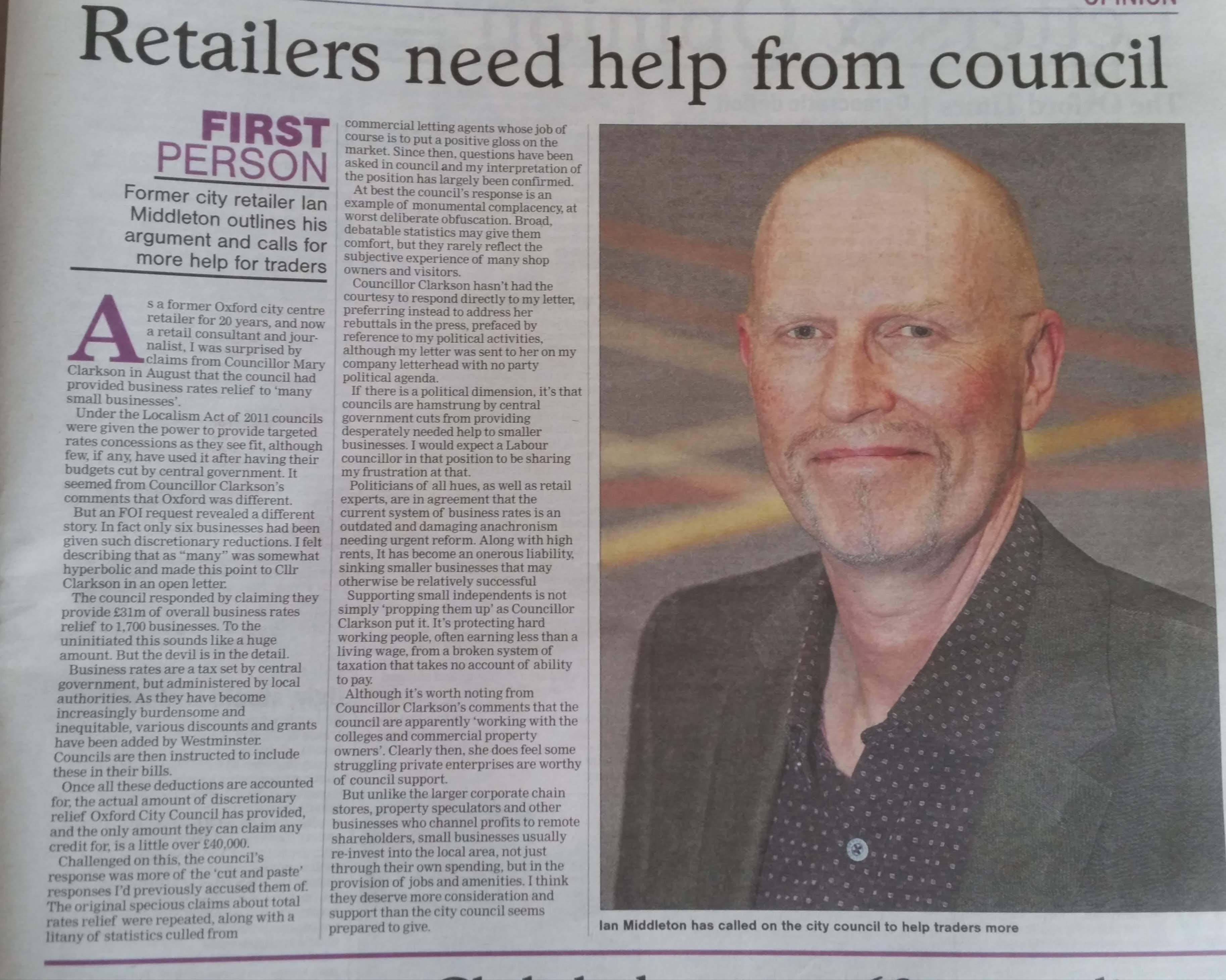
I’ve been fighting for a fairer deal for High Street retail for over 15 years

There soon followed a series of frantic rounds of renegotiation with landlords who themselves were facing the prospect of huge hole in their new developments as retailers started to fall over with alarming regularity. In many cases we were able to come to mutual agreements to keep us trading at the shopping malls looking full, but the one thing that couldn’t be re-negotiated were business rates. Set as they were, by the central valuation office, and administered by local authorities, they were completely devoid of any chance of concession unless you had an understanding council. In my experience their understanding was rather limited, and after 5 years as a local councillor myself I now understand more about why that was.

So we were all caught in a perfect storm that only a few managed to emerge from. My business was one of the luckier ones as I managed to negotiate deals that gave us breathing space. But I could see the writing on the wall and it was telling me to get out of the high street and decamp to the internet where so many of our competitors were lurking. Thereby hangs another very long story.

But suffice to say I have an intimate understanding of the plight of the high street, in fact much more intimate than I would prefer. For that reason one of my personal priorities as a fresh faced new MP would be to push for a new system of business rates or local high street taxation. Other things like rent controls and use classes would also be high on the agenda, but none of this will be an easy fix for an industry in the doldrums after so many years in decline. But I know from my own experience that smaller independents are both the lifeblood of local high streets whilst also being the most vulnerable.

In terms of the dreaded business rates, I think I could take elements from the land tax approach of the Green party and add in some aspect of a local purchase tax as seen in the USA. Such a tax would be far more progressive and have more respect for the ability of businesses to pay such an additional tax. That would give a far greater connection between the local community, local authorities and the retailers themselves. If all retailers did well then they would all reap the benefits.
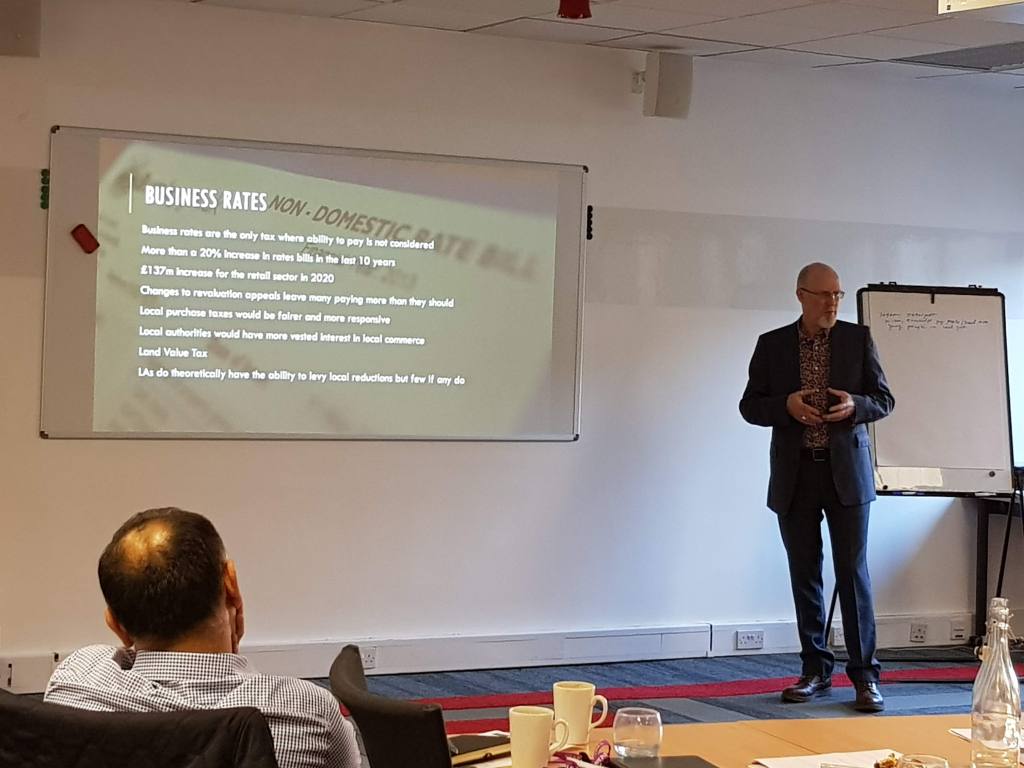
Speaking to local councillors and retailers about business rates reform

I don’t really have the answer to full business rates reform, but I’ve been campaigning for a better system for over 10 years. I would advocate a situation where we involved existing high street retailers in the process of finding a solution. There have been past attempts at doing this, but very few, if any, involved small independent retailers. I think that was a mistake.

The Labour Party have boldly announced that they would scrap the current business rates system, but they haven’t said what they would replace it with. I’ve been here before many times, and both Labour and the Tories have frequently promised reform but never delivered on that. One of the biggest reason is that business rates are a virtually guaranteed income for government bringing in over £13bn a year. Even if the premises are empty, the landlord cops for the bill so it’s a win-win for Westminster. So any new system is likely to be just as iniquitous and damaging, especially to smaller operators.

I think there is a way of developing a system of local high street taxation that could benefit all sides of the equation, including the consumer. Just scrapping the business rates system with no plan for what would replace it is not a solution, yet its the current proposal from the part that is most likely to form the next government in a few weeks. If I was in Westminster I’d hope to be able to provide a far better insight into the problems on the high street and how to engage with the people who face those problems every day.
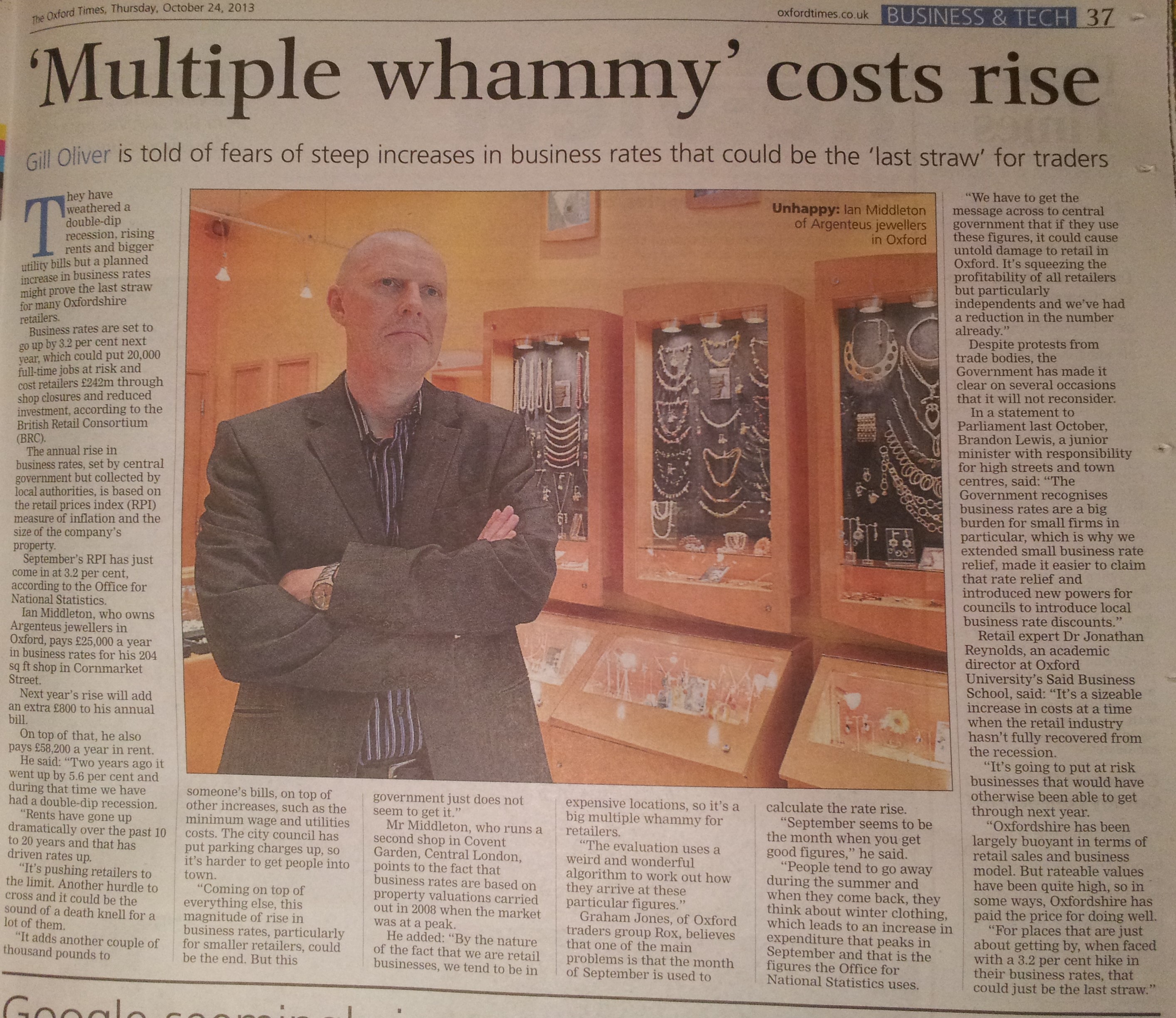
I’d like to see genuine consultation with high street stakeholders, including landlords and local councils, about the best way forwards. As a long term retailer, having moved from being a small business, through a larger expansion and back to being a ‘born again independent’, I’d like to be involved in that process. But I guess it remains to be seen what the outcome is on July 4th.

I’ve just published a video I made during a recent visit to Bicester with some thoughts on how we can work towards a better system of high street business taxation and help to repair our broken high streets and you can watch that by clicking here.

If you’re a retailer or just someone who enjoys browsing physical shops, I’d suggest you vote for someone like me who has the experience to make that a viable possibility again. Retail is at the heart of every village, town and city and needs political support to make it vibrant again. Many politicians claim to have the answer but few of them have been on the inside of the industry. I think that needs to change. I’d like to change it.

Gallery

Business Doesn’t Have To Be Bad

Untitled-1As a businessperson, a long time retailer, and now a retail commentator and journalist, one of the most difficult things for me to reconcile is my involvement in the promotion of consumerism.

That’s at odds with my more recent conviction that we can’t continue to squander the world’s finite resources on WANTS, whilst ignoring the NEEDS of most of the planet’s population.

The Green Party might be seen by some as an anti-capitalist movement. We are however a broad church with many facets. I was encouraged to become a candidate BECAUSE of my business experience rather than in spite of it, and I saw that as an encouraging aspect.

I’ve run large companies, and I now run a small one. I’m probably something of a gamekeeper turned poacher. But I’ve seen both sides of this debate and come to realise that the idea of continual economic growth is indeed a myth. And one we have to stop believing before we run out of road.

I was at the launch of a new book by Naomi Klein a few months ago.  She makes some interesting points about the connections between environmental issues and the global economy.  The basic tenet is that when resources and commodities are monetised on the kinds of scale they are now, the result is economic and environmental catastrophe. And we’re just getting a taste of that.

The direct impacts are of course climate change, which if you ascribe to that view, is starting to bring with it the kinds of drastic changes in weather patterns that we’ve seen in recent years.

These are all things we’re having to come to terms with now and they’re all traceable to global economic activity. They affect all our lives, not just personally, but in broader human and economic terms.

I’m a vocal advocate of social enterprise, and believe that there are many big businesses out there that can be made to take a more ethical and responsible stance if we create the right conditions to encourage it.  And happily for me there is already a growing movement within the more enlightened areas of the business world towards ethical business and sustainable capitalism.

That might sound like some thing of an oxymoron, but in many sectors of business now there’s a realisation dawning that if we continue to squeeze the pips of the economy, we’ll eventually run out of juice.

Amidst calls from some people for a revolution against rampant capitalism, I see the future as more of an evolution towards a business ethos that views social justice and connection with local and national communities as an asset, rather than an inconvenience.  I’m certainly not anti-capitalist, but I am anti-unfettered capitalism. I agree that the market should be allowed to decide some things. But I believe the state has the job of holding us all to account for our actions and tempering the excesses of marketisation to prevent it working against the common good.

And it’s not just us greeny types taking up this mantra. Many key economists and business commentators are now having similar epiphanies about how business and consumption needs to be managed in a sustainable, responsible and accountable way, if we’re all going to avoid a backlash against the kinds of excesses and irresponsible business practices that became prevalent over the past 20 or 30 years.

Essentially businesses need to grow up and take responsibility for the societies we’ve helped to create.

I’ve recently become very interested in something now being called the circular economy, where consumption itself is fed back into the creation of new resources and products.  This doesn’t just encompass recycling, but also upcycling and renewable energy as part of the manufacturing process, along with emergent technologies, social media, and the fourth economy, comprising enterprises that not only make a profit for business owners, but also put something back into the social economy.

That might all sound a bit hippy and tree-huggy, but it’s something that’s being taken very seriously now by many key figures in the business world. Most notably Bill Gates and Richard Branson. And with good reason.

If you can make money with clean conscience, look after your employees, business partners, suppliers, and most importantly the planet AND enjoy what you’re doing, what’s not to like?

You also get to sleep pretty well at night too

So I hope I can convince you that there is scope within a Green World for enterprise and innovation. Without the need for a constantly growing economy and an ever greater consumption of the worlds finite resources.

With the potential for over a million green jobs out there, and an ethical economy that has only scratched the surface of an emerging market, there are plenty of opportunities for business leaders and entrepreneurs in a future Green and pleasant land.

Gallery

Visit to Banbury Market 17th January 2015

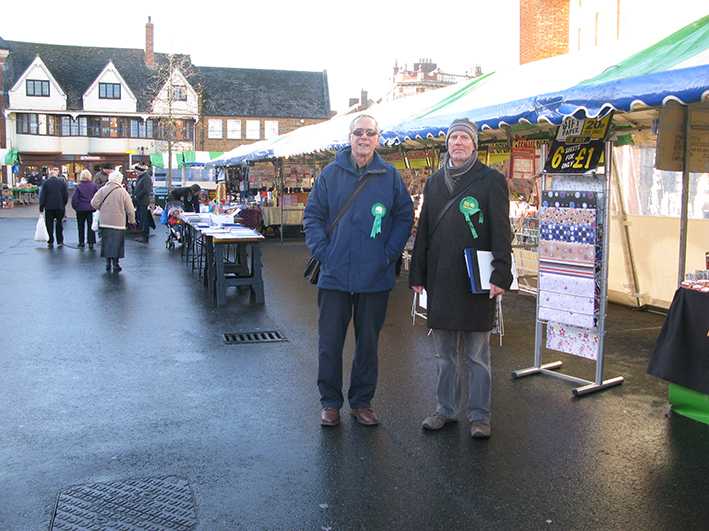
market sheetLast week myself and John Haywood from the Banbury and Cherwell Green Party visited the market in central Banbury to speak to the stall holders about the changes being proposed to this 1000 year old tradition in the heart of an historic town.

We spoke with all the stallholders present, although sadly they were only 10 of them trading on the day.  They were all all opposed to Cherwell District Council’s illogical and damaging decision to restrict the stalls to the Cornhill end of the Market Place.  A plan also supported by the Conservative controlled Town Council.

I started my own 25 year long retail career on a market stall, and worked it for 7 years with my partner though rain, hail sleet, snow and sunshine.  I know how difficult it can be to make a living and how fragile the trading environment can be.  Your livelihood can depend on so many variable factors, and one of the major fears is losing your regular pitch, for whatever reason.

It may seem silly to anyone who hasn’t traded in a market themselves, but where your stall sits can make all the difference between success and failure.  The location of competing trades, the flow of people moving through the market, who your neighbours are, your visibility and prominence in the market as a whole are all desperately important.

There appears to have been absolutely no consultation with stall holders or customers about these unpopular changes, and based on what stallholders and visitors told me I foresee them being the death knell for this historic trading post as more and more traders fall by the wayside.

So what seems like a minor change to the council, will probably be anything but to the people trying to make a living out of the market.  This move could likely kill it off!  it’s already become smaller and therefore less popular, especially over the last 20 years. In 1997 there were 120 stalls, now its down to less than 20.

Considering it’s reduced pull for consumers it’s completely incongruous that the rents being charged by the private firm managing on behalf of the council are almost double that charged by neighbouring markets such as Abingdon, Aylesbury, Hinkley, Oxford and Thame.  And as with most things these days, the rent goes up every year.  Meanwhile trade is slowly dwindling away to nothing, leaving regular and loyal traders quite literally out in the cold.

saleThe Council’s plan includes opening the Market car park for use on Thursdays and Fridays. There is no evidence to suggest this will increase car park usage and revenue to the Council – people already using other car parks such as that near to the Matalan Store will simply park in the market place instead.

Government initiatives on town centre regeneration called for more emphasis and support for market days and the traders that build and run these vital hubs of trade and local amenity in our towns and cities.  The Portas review cited markets as one of the easiest ways that town centres could be revitalised and kept alive.  Why then is the Conservative run Cherwell Council ignoring the views of it’s own established market traders?  Why are they proposing moves that could potentially irreparably damage trade in such an established and once vibrant local fixture?

Banbury market should be seen by Cherwell Council as an asset to the town.  They should be supporting it actively and engaging with the traders and customers to find ways of safeguarding the it’s future, rather than taking unilateral actions with no consultation.

This is a Charter Market, which bestows on Banbury the status of a Market Town.  By birthright it should be located in the Market Square.

I would urge Cherwell councillors to do what I did.  Take a walk around the market and speak to the people whose livelihoods are in their hands.  Speak also to the local residents and patrons of the market and ask them what they think about the priorities that they are planning to enforce on everyone.

This is not a decision that can be taken just by moving squares on a map.

me and john landscape