Gallery

Business Doesn’t Have To Be Bad

Untitled-1As a businessperson, a long time retailer, and now a retail commentator and journalist, one of the most difficult things for me to reconcile is my involvement in the promotion of consumerism.

That’s at odds with my more recent conviction that we can’t continue to squander the world’s finite resources on WANTS, whilst ignoring the NEEDS of most of the planet’s population.

The Green Party might be seen by some as an anti-capitalist movement. We are however a broad church with many facets. I was encouraged to become a candidate BECAUSE of my business experience rather than in spite of it, and I saw that as an encouraging aspect.

I’ve run large companies, and I now run a small one. I’m probably something of a gamekeeper turned poacher. But I’ve seen both sides of this debate and come to realise that the idea of continual economic growth is indeed a myth. And one we have to stop believing before we run out of road.

I was at the launch of a new book by Naomi Klein a few months ago.  She makes some interesting points about the connections between environmental issues and the global economy.  The basic tenet is that when resources and commodities are monetised on the kinds of scale they are now, the result is economic and environmental catastrophe. And we’re just getting a taste of that.

The direct impacts are of course climate change, which if you ascribe to that view, is starting to bring with it the kinds of drastic changes in weather patterns that we’ve seen in recent years.

These are all things we’re having to come to terms with now and they’re all traceable to global economic activity. They affect all our lives, not just personally, but in broader human and economic terms.

I’m a vocal advocate of social enterprise, and believe that there are many big businesses out there that can be made to take a more ethical and responsible stance if we create the right conditions to encourage it.  And happily for me there is already a growing movement within the more enlightened areas of the business world towards ethical business and sustainable capitalism.

That might sound like some thing of an oxymoron, but in many sectors of business now there’s a realisation dawning that if we continue to squeeze the pips of the economy, we’ll eventually run out of juice.

Amidst calls from some people for a revolution against rampant capitalism, I see the future as more of an evolution towards a business ethos that views social justice and connection with local and national communities as an asset, rather than an inconvenience.  I’m certainly not anti-capitalist, but I am anti-unfettered capitalism. I agree that the market should be allowed to decide some things. But I believe the state has the job of holding us all to account for our actions and tempering the excesses of marketisation to prevent it working against the common good.

And it’s not just us greeny types taking up this mantra. Many key economists and business commentators are now having similar epiphanies about how business and consumption needs to be managed in a sustainable, responsible and accountable way, if we’re all going to avoid a backlash against the kinds of excesses and irresponsible business practices that became prevalent over the past 20 or 30 years.

Essentially businesses need to grow up and take responsibility for the societies we’ve helped to create.

I’ve recently become very interested in something now being called the circular economy, where consumption itself is fed back into the creation of new resources and products.  This doesn’t just encompass recycling, but also upcycling and renewable energy as part of the manufacturing process, along with emergent technologies, social media, and the fourth economy, comprising enterprises that not only make a profit for business owners, but also put something back into the social economy.

That might all sound a bit hippy and tree-huggy, but it’s something that’s being taken very seriously now by many key figures in the business world. Most notably Bill Gates and Richard Branson. And with good reason.

If you can make money with clean conscience, look after your employees, business partners, suppliers, and most importantly the planet AND enjoy what you’re doing, what’s not to like?

You also get to sleep pretty well at night too

So I hope I can convince you that there is scope within a Green World for enterprise and innovation. Without the need for a constantly growing economy and an ever greater consumption of the worlds finite resources.

With the potential for over a million green jobs out there, and an ethical economy that has only scratched the surface of an emerging market, there are plenty of opportunities for business leaders and entrepreneurs in a future Green and pleasant land.
Gallery

Your Vote Could Mean The End of the NHS

Horton - BlogWe were told the last election was all about Education – Education – Education. This one should be NHS – NHS – NHS.

The road to privatisation of the NHS has been a long one and began under the Conservatives in 1992 with the Private Finance Initiative.  It’s a neat trick that enables huge amounts of debt to be moved off the national balance sheet whilst still expanding operational infrastructure.

New Labour saw it as something too good to be true, as it allowed them to build new hospitals, without borrowing more money or raising taxes.  But like most things that seem too good to be true, it was.  By the end of their tenure Labour had saddled the NHS with £80Bn in repayments on total capital assets worth around £11Bn, and we’re still paying for it now.

Then along came the Conservatives again who just love to privatise things.  Every time they’ve been in government they’ve privatised something. The trains, electricity, gas, BT, the post office – which they practically gave away.

But the Tories have a problem when it comes to the NHS.  They can’t flat out privatise it, because that’s politically toxic.

So in 2012 – The year that Danny Boyle showed us in his spectacular Olympic opening ceremony what a glorious thing the NHS is – the Conservatives brought in the Health and Social Care Bill.

A bill that many people didn’t even notice passing through parliament.  But a bill that arguably affects all of us more than any other legislation in our lifetime.  A bill based on the premise that the NHS was a poorly performing institution that needed reform and another £3Bn top down reorganisation that we’d been promised before the election wouldn’t happen.  A bill that ignored the core values of the NHS and characterised it’s staff as a problem to be dealt with rather than it’s greatest asset.  A bill that achieved the Tory Nirvana of laying the NHS open to private contractors, furthering their ideology that the state should not be responsible for providing public services.

It effectively legislated against free universal comprehensive healthcare and flung the door to privatisation wide open.  And private health firms are falling over themselves to come inside.

Jeremy Hunt has just announced £780Million worth of private contracts to 11 firms, many of which have a chequered history. Many of them are also donors to the Tory Party.  There are also plans in Staffordshire to privatise cancer care in a £700M contract and ‘End of life care’ worth another £500M

In a leaked confidential document it’s proposed that these contractors will be :

“Given ‘discretion’ to design services they would like to deliver, slash spend per patient and propose the payment structures most beneficial to themselves”.

In that one clause we get a glimpse of how private companies will pervert the ethos of the NHS to their own end.

First the add on services will be an extra cost.  Then any new treatments, drugs or therapies will be extra

In effect we’ll end up with a RyanAir NHS  – Your operation will be free, but they’ll charge you £500 for the bed and another fifty for using the toilet.

The government consistently claims the NHS budget is protected but in reality, it’s being forced to make cuts dressed up as efficiency savings of £15bn – £20bn by the end of this year. No wonder we’re losing services.  And across the country, A&Es, maternity and other services are being closed, with thousands of jobs lost.  Competitive tendering also fragments healthcare. Where patients are sent miles to access different care resources around the country based on contractor costs.

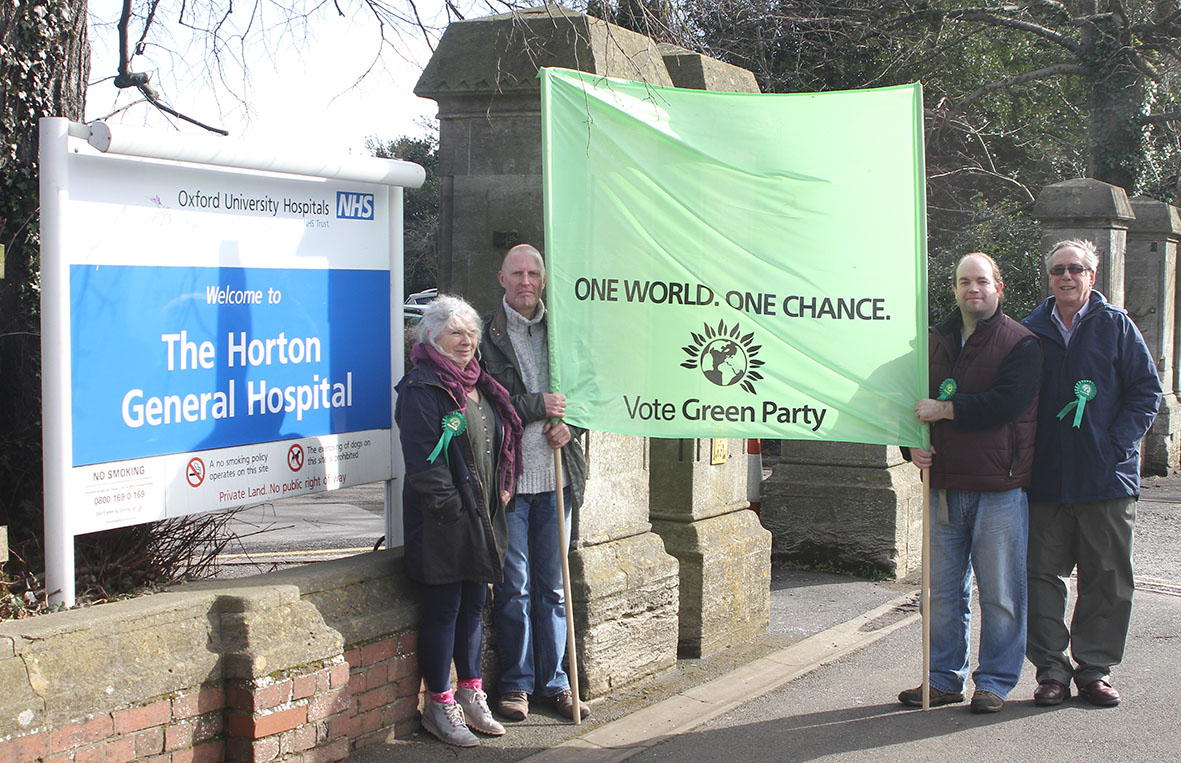
I’m standing as Parliamentary candidate for the Green Party in Banbury, where people are rightfully worried about that fragmentation and the future of their beloved Horton General Hospital.  Labour have already tried to close it once, and more recently the coalition began a reduction in the range of services offered there, with the removal of emergency abdominal surgery facilities. This has resulted in some patients being forced to make a 3 or 4 hour, 50 mile round trip to services at the John Radcliffe Hospital in Oxford.  Not only is this extremely inconvenient, it also potentially impairs patient outcome as additional stress is added to their situation.

Banbury has a long history of returning Conservative MPs, but this time every voter in the constituency has to ask themselves the question – do I still want to have access to a fully free and fully funded NHS in 5 years time?

If the answer is yes you have to remember that, no matter how much you might like the Conservative candidate this time (and I’ll admit I like her too), a vote for Victoria Prentis will just make another Tory led government more of a reality.  No matter how much she says she’ll fight for the Horton, she’ll be forced to follow her party’s privatisation agenda.  Even if she votes against the whip she’ll be a lone voice in a government she helped to put into power.

I want to see an end to all privatisation of the NHS and I believe the NHS should be brought back entirely into public ownership.

The Green Party supports the NHS re-instatement bill, we’d negotiate an exit from PFI and repeal the Health and Social Care Act.  We’d also fight TTIP which could have a huge impact on the NHS. We believe that NHS staff deserve a fair deal and that they should be supported and valued rather than treated as a problem to be dealt with

Aneurin Bevan was once asked how long he thought the NHS would survive.  He replied: “As long as there are folk left with the faith to fight for it.”

Every party is pledging to invest more money into the NHS but the Green Party won’t just invest cash, we’ll also invest our faith.  We all have to show that faith now or by the end of the next parliament Danny Boyle’s proud Olympic love letter to our wonderful NHS could become it’s epitaph.

Gallery

Save Banbury’s Phone Box Library!

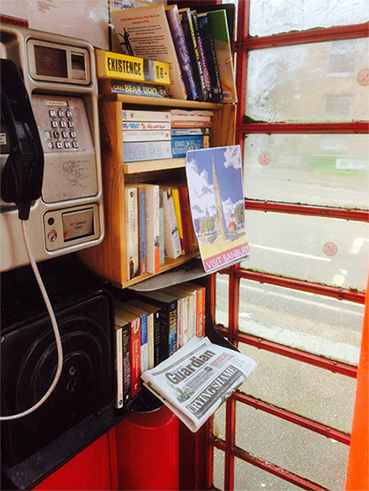
Who’d have thought that a small but effective local community initiative in an Oxfordshire town would attract such global attention?  The Banbury Phone Box Library is one such brilliant piece of local engagement which is now garnering international attention as BT looks towards chopping it off at the knees.

The red phone box is almost as iconic as the red bus as a national symbol of Britain around the world.  You’d think if you were company who owns and operates these highly visible pieces of cultural capital you’d be only too pleased to see them being involved in well supported local campaigns that add value to a service that is perhaps not as loved as it once was.

In that context it seems daft to me that BT are hell bent on annoying small and large communities across the country by removing public call boxes where they’re valued for numerous reasons other than a quick natter on the phone.  It’s even more self-defeating that they’re erasing some of the very symbols of Britishness that have helped them build a world class multi-national company.

It has to be said that the Town Council in Banbury share some of the potential blame if the box is removed, as they are refusing to adopt it (something that BT now allow for the princely sum of £1), if BT go ahead with plans to decommission the phone service in the box.  Previously they struck a deal with BT to adopt the box and save the library and a local steel fabrication firm offered to fix permanent shelves in the box to house the books to assuage BT’s prior objections to the library service on health and safety grounds, as they believed the current shelving arrangements could be dangerous.

BT now claims that it is uneconomic for them to continue to run the service anyway, even though I understand thousands of calls were made from it last year.

The under-story seems to be that BT want out of the call box game at any cost, and most of that cost will be borne by local communities using the boxes for a number of vital social services or simply to make a call when other options are not available to them.

Banbury Town Council now say that they’re not prepared to adopt the box if it is then decommissioned by BT.  Whilst I support taking a stance against the loss of the phone service, I think it would be a sad loss to the community of the box were to be removed as a result of the Town Council refusing to adopt the box itself.

Moreover, If BT are claiming the box is loss making, I think it would be useful for them to provide the figures backing that up. It would at least give us an idea of the likely shortfall which could perhaps be covered in some other way.

It’s also crazy that BT are missing this as an opportunity for some very positive PR. It has to be said that they’re not universally loved as a company, so something like this, that is fairly minimal in cost terms, would seem to be a great way for them to connect with the community.

Going forward perhaps the government needs to bring in a legal requirement on telecoms companies like this to provide a certain number of public call points in an area. Just because most of us carry mobiles now, doesn’t mean that sometimes they might not fail at a vital time, or have been forgotten when they’re most needed.  I know BT used to be obliged to seek permission from local or parish councils in order to remove a box, but it sounds like that requirement has now been watered down.  In very rural areas mobile phone reception is also notoriously patchy.  In those areas call boxes provide a vital service for emergency calls.

In terms of usage statistics, it might also be interesting to track the number of calls made against the minimum price of a call in a phone box, which I understand is now 60p. Perhaps BT need to be reminded of the law of supply and demand.

If you’re on Twitter you can follow and support the campaign to save the Banbury Phone Box Library by following the hashtag